
Nubra Valley in winter is one of Ladakh’s best-kept secrets. While most travel guides push you toward the summer rush — camel rides under blue skies, crowds at the sand dunes, fully-booked camps along the Shyok River — a quieter, more intimate version of this valley waits for those willing to arrive when the temperatures drop and the tourist buses stay home. If you’ve been wondering whether Nubra Valley in winter is actually worth the effort, the honest answer is: yes, but only if you go prepared and stay somewhere truly comfortable.
This guide covers everything — temperatures, road access, what to do, what to expect, and the one accommodation in Hunder that makes a winter visit not just possible, but genuinely magical.
What Is Nubra Valley Like in Winter?
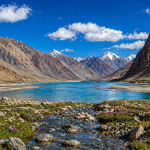
Nubra Valley sits at approximately 10,000 feet above sea level, which actually makes it warmer than Leh at 11,500 feet. That said, winter here is no gentle affair. From November through February, temperatures routinely drop to -10°C at night and hover between -5°C and 5°C during the day. The Shyok River slows, the apricot trees stand bare, the sand dunes of Hunder wear a thin crust of frost, and the Karakoram peaks glow white against impossibly blue skies.
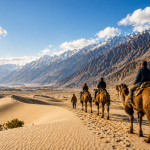
What winter strips away is noise. The summer crowds vanish entirely. Diskit Monastery, which in peak season has tour groups filing through every hour, becomes a place of real stillness. The Bactrian camels, still present in Hunder, grow thick shaggy coats and wander the dunes with an unhurried patience that summer tourists rarely see. The sky at night — with zero light pollution and cold, dry air — becomes something that no photograph can fully capture.
Nubra Valley in winter is not a destination for people who need convenience. It is a destination for people who want an experience that’s genuinely rare.
Winter Temperatures Month by Month
Understanding the temperature range helps you plan clothing, activities, and expectations:
October: Transition month. Days are crisp and golden, ranging from 5°C to 15°C. Roads are open, crowds are thinning. This is arguably the best shoulder-season window.
November: Winter sets in seriously. Daytime highs drop to around 2°C to 5°C, nights hit -5°C to -10°C. The valley is very quiet. A few guesthouses remain open.
December: Cold deepens. Lows can touch -15°C overnight. The Losar Festival — Ladakh’s traditional New Year celebration — brings rare cultural colour to an otherwise silent landscape. Nubra Valley in winter during Losar is worth planning around.
January: The harshest month. Temperatures can fall below -20°C at night in sheltered valleys. Road conditions over Khardung La are unpredictable. Not recommended unless you have significant cold-weather experience.
February: Temperatures begin their slow recovery. The Dosmoche Festival is held at Diskit Monastery in late February — a spectacular mask dance and ritual celebration of the lunar new year that very few outsiders ever witness. This is the most culturally rich time to visit Nubra Valley in winter.
March: Roads begin to stabilise. Temperatures rise toward 5°C to 8°C by day. Early spring begins arriving in the valley before it does in Leh.
Are Roads Open to Nubra Valley in Winter?
This is the most critical question for anyone considering Nubra Valley in winter, and the answer is nuanced.
The main route from Leh crosses Khardung La Pass at 17,982 feet. Nubra mostly remains connected by road, but sometimes heavy winter snowfall at Khardung La pass blocks the road temporarily. The Border Roads Organisation (BRO) works to keep the pass open year-round, as it serves as a strategic military supply route. However, after heavy snowfall — particularly in January and early February — closures of 24 to 72 hours can happen without warning.
The practical advice is simple: always check road status with Leh-based taxi drivers or the BRO the morning before you plan to cross. Build flexibility into your itinerary. Do not book a return flight the same day you intend to drive back over the pass.
If you are visiting Ladakh in winter, it is advisable to check the road status before planning. Fly into Leh — flights from Delhi operate year-round — acclimatise for a day, and then make the crossing.
Things to Do in Nubra Valley in Winter
One of the biggest misconceptions about Nubra Valley in winter is that there is nothing to do. The reality is that what’s available shifts from outdoor activity to something slower and often more meaningful.
Visit Diskit Monastery in silence. In summer, the monastery is rarely quiet. In winter, you may be the only visitor. The 106-foot Maitreya Buddha statue overlooking the frozen valley has a presence that crowds dilute.
See the Bactrian camels in their winter coats. Winter offers special moments, like spotting shaggy double-humped Bactrian camels in thick winter coats. The sand dunes of Hunder look extraordinary with frost along their ridges and camels resting among them.
Attend the Dosmoche or Losar Festival. Two major festivals are celebrated during winter — Dosmoche festival is observed in late February, a celebration of the New Year, and Losar festival is held in December. These are authentic cultural events with mask dances, monastery rituals, and local community gatherings that most tourists never experience.
Stargaze from your accommodation. Stargazing under crystal-clear skies is one of winter’s special offerings in Nubra. Cold, dry air means exceptional visibility. With zero light pollution around Hunder, the Milky Way is visible to the naked eye on clear nights.
Walk the villages. Hunder, Diskit, and Sumur become quiet enough in winter that you can walk through them without feeling like an intruder. Locals are genuinely warm and the pace of life slows to something almost meditative.
Soak in Panamik Hot Springs. The natural sulphur springs at Panamik, about 30 km from Hunder, are particularly rewarding in winter — soaking in hot mineral water while surrounded by snow-covered mountains is an experience with very few rivals.
What to Pack for Nubra Valley in Winter
Preparation is everything for Nubra Valley in winter. Here is what you should not leave Leh without:
- Thermal base layers (top and bottom), at least two sets
- Heavy down jacket rated to -20°C
- Woollen socks and waterproof insulated boots
- Balaclava, windproof gloves, and thermal hat
- Sunscreen (SPF 50+) — winter sun at altitude is deceptively strong
- Power bank and hand warmers — batteries drain fast in extreme cold
- Cash in small denominations — ATMs beyond Leh are unreliable in winter
- Any prescription medications and basic first aid — pharmacies are scarce
- An Inner Line Permit (ILP), obtainable online or at the DC office in Leh
Where to Stay in Nubra Valley in Winter
This is where most guides fall short. The honest picture is that the majority of hotels, camps, and guesthouses in Nubra Valley close entirely between November and April. Only a few homestays and guesthouses remain open with basic facilities, and food options are limited.
For travellers comfortable with minimal amenities, local homestays in Diskit and Hunder are a warm and culturally rich option. Expect simple meals, shared bathrooms, and sleeping under heavy woollen blankets with a bukhari (traditional wood-burning stove) keeping the room alive.
For travellers who want privacy, warmth, and something closer to genuine comfort without sacrificing the raw beauty of Nubra Valley in winter, there is one property in Hunder that operates on an entirely different philosophy.
Hill Crest Nubra — Hunder’s Only Private Estate
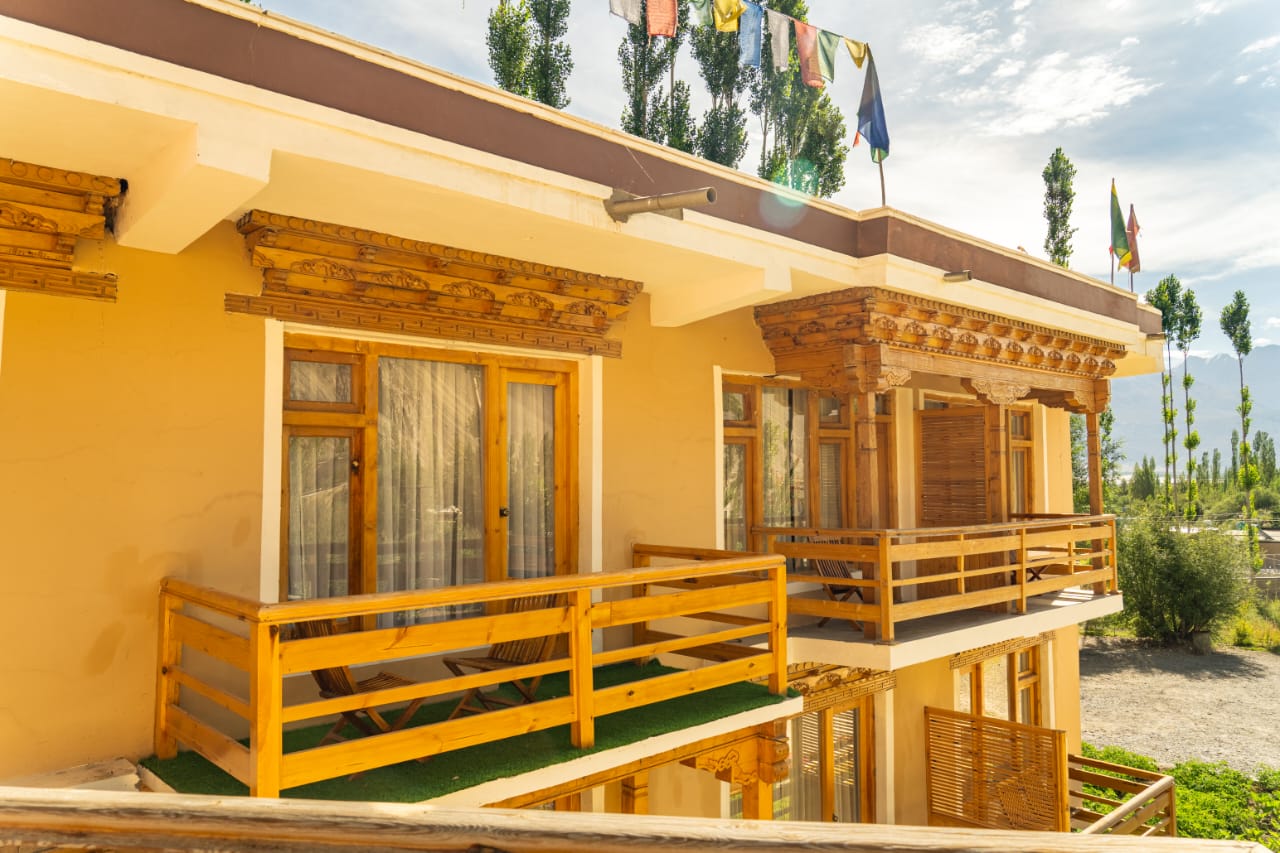
Hill Crest is not a typical hotel. It is a single-suite, 2-acre private estate in Hunder — meaning the entire property, its garden, terrace, and staff, belongs exclusively to you and your party during your stay. There are no neighbours, no shared dining rooms, no other guests walking past your window at dawn.
What makes Hill Crest particularly suited for Nubra Valley in winter is exactly this privacy. When the valley is at its most raw and atmospheric, you want a base that matches that quality. A personal chef prepares Ladakhi meals on your schedule. A host and guide plan your days — monastery visits, village walks, camel safaris across the frost-dusted dunes that are a short walk from the property. Evenings are yours on a private deck under skies that, in winter, belong to a galaxy worth staying up to see.
Hill Crest does not offer the cheapest experience of Nubra Valley in winter. It offers the best one. For couples, honeymooners, photographers, or anyone who has come this far and wants to be fully present in one of the Himalaya’s most extraordinary landscapes, it is the answer to the question of where to stay.
To check availability for a winter stay, visit hillcrestladakh.com.
Book Your Winter Stay at Nubra Valley
Experience Nubra Valley in winter like never before — in complete privacy, comfort, and style.
Hill Crest Nubra is Hunder’s only private single-suite estate. When you book with us, the entire 2-acre property — the garden, the terrace, the staff — is exclusively yours.
Practical Tips Before You Go
A few final notes for anyone planning Nubra Valley in winter:
Fly into Leh rather than driving up from Manali — the Manali-Leh highway is completely closed in winter. Spend at least one full day in Leh acclimatising before attempting Khardung La. Altitude sickness at 10,000 feet is less common than at Leh, but the crossing itself reaches nearly 18,000 feet, and the descent must be done carefully.
Carry a satellite communicator or inform someone of your itinerary, particularly if you are travelling in January or February when conditions are at their most serious. Hire a local driver from Leh who knows the road in winter — this is non-negotiable. Local knowledge of when to turn back is worth more than any map.
And finally, go slowly. The valley rewards stillness. Nubra Valley in winter is not about ticking sights off a list. It is about sitting with a cup of butter tea and watching snow fall on the Karakoram in complete quiet. For those who can receive that kind of experience, it will be the trip they talk about for the rest of their lives.
Frequently Asked Questions (FAQs)
Q: Is Nubra Valley accessible in winter?
Yes, Nubra Valley in winter is generally accessible via Khardung La, which the Border Roads Organisation tries to keep open year-round. Temporary closures after heavy snowfall can last 24–72 hours, so always check road conditions the morning of your crossing.
Q: What is the temperature in Nubra Valley in winter?
Temperatures range from approximately -10°C to 5°C between November and February, with January being the coldest month. Nights can occasionally drop below -20°C during cold snaps.
Q: What are the best months to visit Nubra Valley in winter?
Late October and February are the most rewarding. October offers clear roads and golden light, while February brings the Dosmoche Festival at Diskit Monastery — one of the most spectacular cultural events in Ladakh.
Q: Which hotels stay open in Nubra Valley in winter?
Most properties close from November to April. A small number of homestays remain open, and Hill Crest Nubra in Hunder operates as a private single-suite estate year-round, offering full board and private guided experiences.
Q: Is Nubra Valley in winter good for couples or honeymooners?
Absolutely, The combination of total privacy, extraordinary landscapes, night skies, and the absence of tourists makes Nubra Valley in winter one of the most romantically isolated destinations in India.
Q: Do I need a permit to visit Nubra Valley in winter?
Yes, An Inner Line Permit (ILP) is mandatory year-round regardless of season. As of 2025, it costs Rs 560 per person and can be obtained online or at the DC office in Leh.
Q: What is there to do in Nubra Valley in winter?
Visiting Diskit and Samstanling monasteries, seeing Bactrian camels on the Hunder dunes, attending the Losar or Dosmoche festivals, stargazing, soaking in Panamik hot springs, and walking the quiet villages of Hunder and Sumur are all excellent winter activities.
Q: How do I get to Nubra Valley in winter?
Fly into Leh from Delhi (flights run year-round), acclimatise for one day, then hire a local taxi or jeep for the crossing over Khardung La. The drive from Leh to Hunder takes approximately 4–5 hours depending on road conditions.