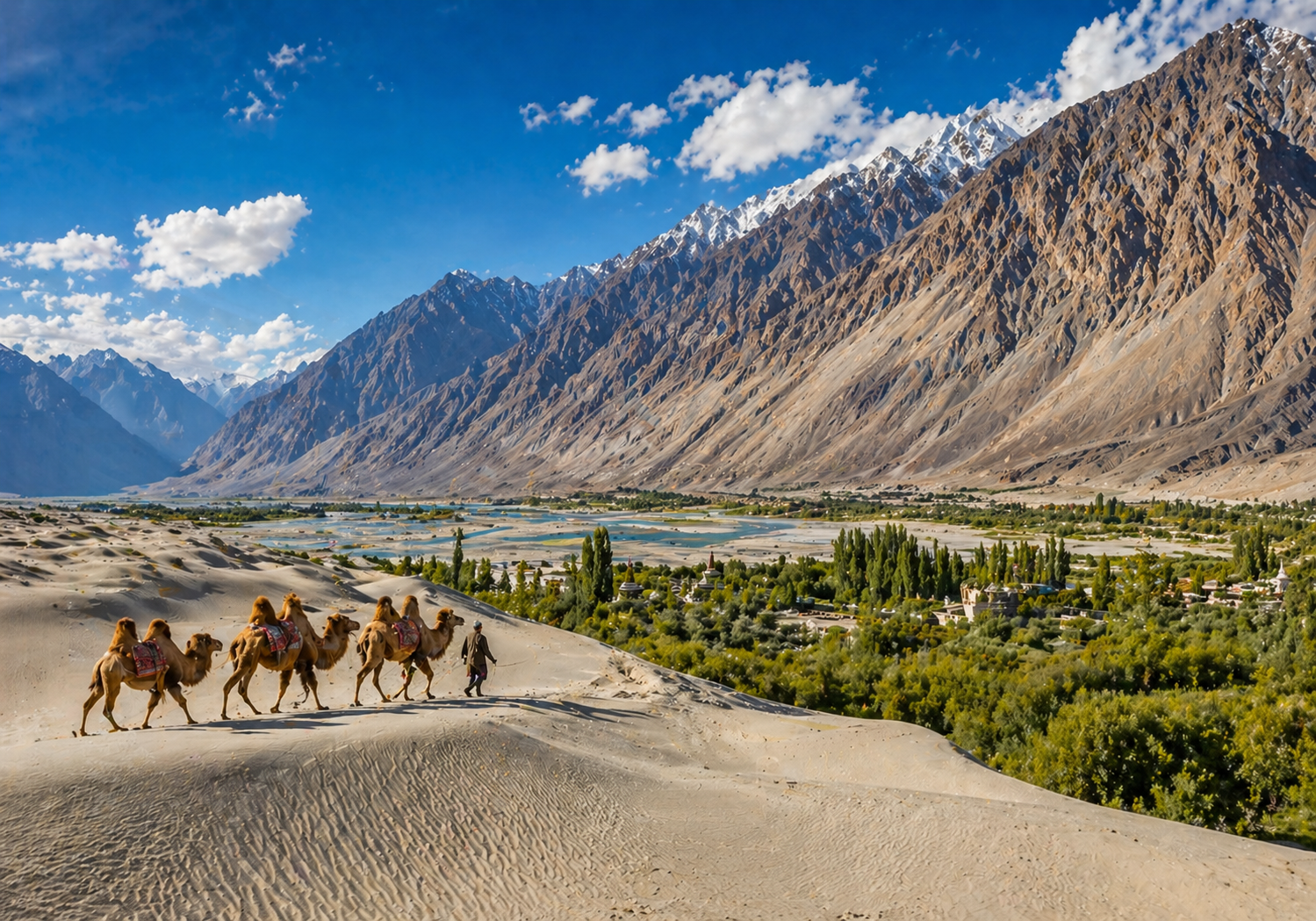

Hunder Village Ladakh is one of those rare places that forces you to question everything you thought you knew about landscape. This is a desert — white sand dunes rolling under an open sky. But look left and there are snow-capped Himalayan peaks. Look right and the Shyok River carves a green ribbon through the arid valley. Look straight ahead and a double-humped Bactrian camel sways slowly across the dunes, bells clinking softly in the silence.
This is not the Rajasthan desert you’ve seen a hundred times on Instagram. Hunder Village Ladakh sits at roughly 10,000 feet above sea level — making it one of the world’s highest cold deserts. It is a place where geography breaks its own rules, and where the past and present exist side by side in a way that few destinations can match.
If you’re planning a trip to Ladakh and haven’t put Hunder Village Ladakh on your itinerary, this guide is your reason to change that.
Where Exactly Is Hunder Village Ladakh?
Hunder Village Ladakh is located in the Nubra Valley, approximately 150 km north of Leh. It sits where the Shyok River and the Nubra River converge, surrounded by the Ladakh and Karakoram mountain ranges. The village is about 7 km beyond Diskit, the administrative headquarters of Nubra Valley.
The only road to reach there is from Leh passes over the Khardung La Pass — one of the highest motorable roads in the world at 5,359 metres (17,582 ft). The drive from Leh takes approximately 4 to 6 hours depending on road conditions, weather, and how many times you stop to photograph the scenery (spoiler: many times).
Strategically, it is one of the most important points in the entire region — it lies close to the Siachen Glacier, the world’s highest battlefield, and was historically the northern edge of the territory open to tourists until 2010, when access to Turtuk village was unlocked.
The Cold Desert: Why Hunder Village Ladakh Defies Logic
Most people expect Ladakh to mean mountains, lakes, and monasteries. What they don’t expect — and what makes it so disorienting in the best possible way — is a desert.
The sand dunes of Hunder Village Ladakh are pale and fine, shaped by the wind into low ridges that glow amber at sunrise and silver at dusk. The dunes stretch for several kilometres between Hunder and Diskit, bordered by seabuckthorn shrubs, poplar trees, and the glint of the Shyok River. The contrast — sand below, snow above — is what makes this landscape feel almost hallucinatory.
Unlike the scorching deserts of Rajasthan, the cold desert of Hunder Village Ladakh is exactly what its name suggests: arid but cold, especially after sunset. Temperatures can drop sharply in the evenings even in summer, so layering up is non-negotiable even in July.
Best Time to Experience the Dunes
The golden hours — early morning and the hour before sunset — are when the sand dunes of Hunder Village Ladakh are at their most photogenic. The low-angled light throws long shadows across the ripples of sand and turns the peaks behind them deep rose. If you’re staying in Hunder overnight (strongly recommended), you get both.
The Bactrian Camels: Living Relics of the Silk Route
The most iconic sight in Hunder Village Ladakh is not the sand dunes. It’s the camels that walk across them.
The Bactrian camels of Hunder Village Ladakh are rare, double-humped animals native to Central Asia. Their ancestors were the workhorses of the ancient Silk Route — the overland trade network that connected China, Central Asia, and the Indian subcontinent from the 2nd century BC onwards. These camels carried silk, wool, saffron, and spices across the Karakoram mountains into Ladakh and beyond. Their two humps — unlike the single-humped dromedaries of Arabia and Rajasthan — help them store fat and survive the extreme cold and altitude of the Himalayan trade routes.
When the Indo-China War in 1962 closed the Silk Route through this corridor, the camels were left behind in Nubra Valley. They adapted, survived, and multiplied. In the 1990s, as tourism in Ladakh began to grow, the villagers over there began offering camel safaris across the dunes — simultaneously providing a livelihood and ensuring the conservation of an endangered species.
Camel Safari: What to Expect
Camel rides in Hunder Village Ladakh typically operate in the morning and late afternoon — the two coolest and most scenic parts of the day. Rides range from 15 minutes to an hour, priced around ₹300–₹500 for a short ride. The camels are managed by local families who have cared for them for generations.
There’s something quietly profound about riding a Bactrian camel through the dunes of Hunder — you are, in a very literal sense, doing what Silk Route traders did centuries ago across this exact terrain. The bells around the camel’s neck. The creak of the saddle. The soft scrunch of sand underfoot. It’s a detail that most travel photographs can’t capture but that every visitor remembers.
The History Hidden in Hunder Village Ladakh
It was the capital of the erstwhile Nubra Kingdom in the 17th century. Evidence of this royal past survives in the ruined palace on the outskirts of the village and the ancient Hunder Monastery (Gompa), which houses a gilded Chamba statue. The village also has hundreds of old chortens — Buddhist stupas — scattered through its fields, a quiet reminder of centuries of devotion.
Beyond its royal history, it sits directly on what was once the busiest stretch of the Ladakh Silk Route. Traders from Mongolia, China, Turkestan, and Kashmir passed through this valley carrying their goods north via the Karakoram Pass or south toward Leh and the Indian plains. The village was a critical rest stop — a place to water camels, trade goods, and shelter from the mountain cold.
Walking through Hunder Village Ladakh today, past its apricot orchards and mud-brick homes strung with prayer flags, that history feels astonishingly close.
Things to Do in and Around Hunder Village Ladakh
1. Walk the Sand Dunes at Sunset
Skip the crowd near the camel enclosure and walk further along the dunes toward the Shyok River. At golden hour in Hunder Village Ladakh, you’ll often find stretches of sand entirely to yourself.
2. Visit Diskit Monastery
About 7 km from Hunder , Diskit Monastery is the oldest and largest in Nubra Valley. The 32-metre Maitreya Buddha statue overlooking the valley is one of Ladakh’s most iconic sights.
3. Stargazing After Dark
With almost no light pollution, Hunder Village is one of the finest dark-sky locations in India. On a clear night, the Milky Way is visible to the naked eye. If you’re staying at a private estate like Hill Crest Ladakh, stepping outside after dinner means walking into a sky full of stars with the dunes silhouetted below.
4. Day Trip to Turtuk
From Hunder Village Ladakh, the road continues north toward Turtuk — one of India’s last villages before the Line of Control with Pakistan. The Balti culture, apricot gardens, and dramatic landscape make it a worthwhile half-day trip.
5. Panamik Hot Springs
About 40 km from Hunder Village Ladakh, the natural sulphur springs at Panamik are a wonderful end to an active day in the valley.
How to Reach Hunder Village Ladakh
All routes to Hunder Village pass through Leh, which is connected to Delhi, Mumbai, and Srinagar by air (Kushok Bakula Rimpochee Airport). From Leh:
- Via Khardung La (most common): Leh → South Pullu → Khardung La → North Pullu → Khalsar → Diskit → Hunder. Approximately 150 km, 4–6 hours.
- Via Wari La (alternate): Sakti → Wari La → Agham → Khalsar → Hunder. A longer but less crowded route.
- Permit required: Indian nationals no longer need an Inner Line Permit for Nubra Valley as of 2014. Foreign nationals still require a Protected Area Permit, obtainable in Leh.
Note: There are no ATMs beyond Leh. Carry sufficient cash. Only postpaid BSNL and Airtel SIM cards work in Hunder Village Ladakh — prepaid and other networks lose signal after Khardung La.
Where to Stay in Hunder Village Ladakh
It has a range of accommodation options — from basic guesthouses and Swiss-style tent camps to boutique stays. The majority of camps and hotels operate between May and October; most close during the winter months when temperatures become extreme.
For those seeking an exclusive experience, Hill Crest Ladakh is a 2-acre private estate in Hunder that takes one party at a time — meaning the entire property, its garden, its views of the dunes and mountains, are yours alone. It’s the kind of stay that turns a visit to Hunder Village Ladakh from a stop on a Ladakh itinerary into a destination in its own right. BOOK NOW !
Practical Tips for Hunder Village Ladakh
- Acclimatise in Leh first: Spend at least one full day in Leh before driving to Hunder. Altitude sickness is real at 10,000+ feet.
- Best months: May to September for warm days and open roads. July–August brings occasional rain. September and October offer clearer skies and fewer tourists.
- Layer up: Evenings in Hunder Village Ladakh can be cold even in midsummer. A down jacket is essential after sunset.
- Cash only: No card machines operate in Nubra Valley. Withdraw enough before leaving Leh.
- Oxygen levels: Exertion at altitude feels harder. Walk slowly, drink water, and don’t rush.
- Respect the environment: The sand dunes of Hunder Village Ladakh face ecological pressure. Carry out all waste and avoid disturbing the natural landscape.
Final Word: Why Hunder Village Ladakh Is Worth Every Kilometre
Hunder Village Ladakh is the kind of place that doesn’t announce itself. It doesn’t have a marketing campaign or a TripAdvisor badge. What it has is a landscape that doesn’t belong to any single geography — part desert, part Himalayan valley, part ancient trading post — and a silence that the rest of Ladakh’s more famous destinations have long since lost.
Whether you come for the camels, the dunes, the stars, or simply the experience of standing somewhere that feels genuinely unlike anywhere else on Earth, Hunder Village Ladakh will earn its place in your travel memory.
Plan ahead, acclimatise well, carry cash, and give yourself at least one night here. The desert in the sky is worth it.
Frequently Asked Questions
Is Hunder Village Ladakh worth visiting?
Absolutely. Hunder Village Ladakh offers a landscape and experience you won’t find anywhere else in India — high-altitude sand dunes, Bactrian camels, Silk Route history, and some of the clearest night skies in the country.
How far is Hunder from Leh?
Hunder Village Ladakh is approximately 150 km from Leh. The drive via Khardung La takes 4 to 6 hours depending on road and weather conditions.
What is the best time to visit Hunder Village Ladakh?
May to September is the peak travel window. June, July, and August offer the warmest days. September and October are increasingly popular for clearer skies and thinner crowds.
Do I need a permit to visit Hunder Village Ladakh?
Indian nationals no longer require a permit for Hunder Village Ladakh as of 2014. Foreign nationals still need a Protected Area Permit, available through registered travel agencies or the DC office in Leh.